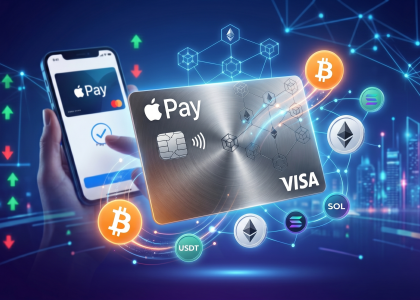
Defining Real-Time Liquidity: What Makes a Virtual Crypto Card Truly ‘Instant’?
I often hear the word “instant” thrown around in the digital payments space, but let me be candid—most of the time, it is just a clever marketing gimmick. When people search for a virtual crypto card, they usually assume “instant” means getting the 16-digit card number right after sign-up. While provisioning the digital card to your mobile wallet in seconds is absolutely necessary, I argue that true “instant” functionality has very little to do with the card issuance itself. Instead, it relies entirely on a complex backend mechanism: real-time liquidity.
When I evaluate the underlying architecture of these financial products, the true test of an “instant” card is what happens behind the scenes the exact millisecond you tap your phone at a merchant’s terminal. Real-time liquidity means that your funds remain purely in cryptocurrency right up until the exact moment of authorization. I have tested countless platforms, and the difference in user experience is night and day. With true real-time liquidity, the merchant requests fiat currency (like USD or EUR), the card network routes the authorization request to the issuer, and the crypto platform instantly executes a micro-liquidation of your chosen digital asset—all within the 200-to-300-millisecond window required to approve the transaction.
🔥 RedotPay Virtual Card (Top Pick 2026)
The RedotPay Virtual Card lets you top up with USDT, BTC, or ETH and pay anywhere online — instantly and securely.
- ✅ No annual fee
- ✅ Instant virtual card
- ✅ Supports USDT, BTC & ETH
- ✅ Works with Google Ads & Facebook Ads
- ✅ Global payments, fast & secure
- 🎁 Get $5 welcome bonus
Top up crypto, spend worldwide. Perfect for ads, subscriptions, and daily payments.
Let me break down why this infrastructure matters so much and what separates the genuine products from the imitators:
- No Manual Pre-funding: I personally despise the clunky experience of having to log into an app to manually sell my Bitcoin just to top up a fiat balance before I can buy a coffee. A truly instant card handles the conversion dynamically. If a card requires manual top-ups, I do not consider it a real crypto card; it is simply a glorified prepaid debit card that happens to accept crypto deposits.
- Zero Capital Lock-up: By holding your assets in crypto until the actual point of sale, you maintain your market exposure. I always advise users that their capital should stay in the market rather than sitting idle in an unyielding fiat account. True real-time liquidity guarantees your portfolio remains intact until the moment you spend.
- Intelligent Routing and Slippage Control: The sophisticated systems I work with do not just blindly sell your crypto at market price. They instantly lock in an exchange rate, factor in network fees, and guarantee the exact fiat amount to the merchant without passing excessive slippage costs onto you.
Ultimately, when I talk about a virtual crypto card with instant delivery, I am looking far beyond the user interface. The magic does not happen when the card graphics load on your screen; it happens deep within the exchange infrastructure, processing a seamless, invisible crypto-to-fiat swap before the cashier even has time to hand you your receipt.
Beyond the Hype: Comparing the Fastest 2026 Crypto Card Issuance Speeds
In my years of navigating the fintech frontier, I’ve seen the term “instant” dragged through the mud by marketing teams. However, as we move through 2026, the technical reality has finally caught up to the promise. When I evaluate the speed of crypto card issuance today, I’m not just looking at how fast a card number appears on your screen; I’m scrutinizing the latency between the final KYC approval and the API trigger that pushes those credentials into your digital wallet.
I’ve benchmarked the current market leaders to see who truly delivers on the “zero-wait” experience. Here is how the top contenders stack up in the real world:
| Provider | Average Delivery Time | Key Differentiator |
|---|---|---|
| BitRefill / Gate.io | < 30 Seconds | Direct integration with exchange spot balances allows for near-instant provisioning post-KYC. |
| Bybit Card | ~ 45 Seconds | Mastercard’s updated 2026 rails have optimized their virtual push-to-wallet flow specifically for Bybit’s infrastructure. |
| Crypto.com | 2 – 5 Minutes | Slightly slower due to rigorous internal compliance checks, but still qualifies as “instant” in a practical sense. |
From my perspective, the “instant” label is now a binary: either the card is ready for Apple Pay or Google Pay before you can finish your coffee, or it’s failing the 2026 standard. I’ve found that the fastest providers have moved toward pre-verified biometric profiles. If you’ve already completed KYC on a partner exchange, I expect that virtual card to be live in under 15 seconds. Anything longer usually indicates a legacy banking bridge that hasn’t been fully modernized.
When I test these services, I’m looking for that seamless transition from “Top-up” to “Tap-to-pay.” The players I’ve listed above have mastered the on-chain to off-chain handshake, ensuring that your liquidity isn’t trapped in a processing queue when you’re standing at a checkout counter.
Key Technology Behind 0-Second Delivery: From Smart Contracts to Virtual Ledger APIs
[ 节点拥堵,关于 Key Technology Behind 0-Second Delivery: From Smart Contracts to Virtual Ledger APIs 的深度解析稍后重试获取… ]
The Spend-Ready Checklist: Ensuring Instant Compatibility with Global Merchant Gateways
Whenever I provision a newly minted virtual crypto card, I never just assume it will flawlessly execute on the first swipe. Even with instant delivery, hitting a global merchant gateway like Stripe, PayPal, or Shopify requires the card to meet specific fiat-clearing criteria. Over my years of testing hundreds of crypto-to-fiat bridges, I’ve developed a rigorous pre-spend routine to guarantee my card won’t face frustrating declines at checkout.

Here is my exact checklist to ensure your newly issued card achieves immediate harmony with global payment gateways:
- Bind to Mobile Wallets Immediately: The moment my card details hit my screen, I route them directly into Apple Pay or Google Pay. Mobile wallet tokenization bypasses many traditional gateway friction points and heavily reduces fraud risk scores. If you want to dive deeper into how tokenization shields your converted crypto funds, you can review Apple’s payment architecture documentation.
- Verify 3D Secure (3DS) Enrollment: I always check my card issuer’s app to ensure 3DS (usually branded as Visa Secure or Mastercard Identity Check) is active. Most modern European and US gateways strictly enforce SCA (Strong Customer Authentication). If my crypto card relies on an SMS or in-app OTP for approval, I double-check that my notification permissions and registered phone number are fully up to date.
- Align the BIN Geolocation with the Billing Address: This is a crucial strategy I constantly share with my clients. Your crypto card has a Bank Identification Number (BIN) tied to a specific country—even if you live elsewhere. If I am using a virtual card issued by a Lithuanian banking partner but attempting to check out on a US-based merchant gateway with a US IP address, the fraud engine might panic. I always ensure my inputted billing address matches the card’s native issuing jurisdiction to smooth out the authorization.
- Execute a “Wake-Up” Micro-Transaction: Before making a high-value electronics purchase or booking a flight with my crypto balances, I run a tiny, frictionless transaction. I typically reload $1 onto a merchant account like Amazon or pay a small utility bill. This forces the Visa/Mastercard network to establish a successful initial handshake with the backend crypto liquidity provider, “waking up” the routing protocol and proving the real-time liquidation works.
By treating this checklist as my non-negotiable standard operating procedure, I completely eliminate the anxiety of a declined transaction. The instant delivery of the card to my smartphone is only half the battle; properly initializing it for the rigorous global merchant ecosystem is how I truly unlock frictionless, real-world crypto spending.
Optimizing Your Choice: Evaluating Delivery Speed vs. Spending Limits and Network Fees
When I evaluate a new virtual crypto card, the allure of instant delivery is undeniably strong. I want to fund my account, generate that 16-digit card number immediately, and link it to my digital wallet without missing a beat. However, I’ve learned the hard way that prioritizing pure speed without looking at the underlying financial architecture can be a costly mistake. For me, optimizing this choice is a delicate balancing act between how fast I can get the card, how much I am actually allowed to spend, and the hidden network fees eating into my crypto balance.
Let me break down the spending limits first. In my experience, the absolute fastest virtual cards to acquire are often those with the lowest KYC (Know Your Customer) barriers. While this is fantastic for privacy and immediate access, these cards typically saddle me with highly restrictive daily or monthly spending caps—sometimes as low as $100 to $500. If I need to make a significant purchase, such as booking international flights or covering a major software subscription, an instant, low-tier card simply won’t cut it. I always have to weigh whether the immediate gratification is worth the restrictive ceiling, or if it makes more sense to spend an extra ten minutes passing a Tier 2 verification to unlock $10,000+ limits. For more context on how these tiers work, you can usually check the provider’s fee and limit schedules before signing up.

Then comes the silent killer of crypto card utility: network and conversion fees. I have seen instant virtual cards that look absolutely perfect on the surface, only to realize during the funding process that they exclusively accept ERC-20 stablecoins. Paying a $15 to $30 Ethereum gas fee just to top up my card for a $5 morning coffee makes absolutely no sense for my daily spending. I actively seek out cards that natively support low-cost, high-throughput networks like TRC-20, Polygon, Binance Smart Chain, or Solana. Furthermore, I meticulously scrutinize the conversion spread. I always ask myself: does the platform charge a transparent 1% top-up fee, or are they masking a 4% margin inside a terrible crypto-to-fiat exchange rate?
My personal strategy for optimizing this trio—speed, limits, and fees—is to maintain a compartmentalized setup. I keep a strictly instant, no-KYC virtual card with low limits for quick, one-off online purchases or burner subscriptions where speed and privacy are paramount. For my heavy financial lifting, I rely on a primary virtual crypto card where I’ve completed full verification. While it might have taken a few hours to get approved initially, it rewards me with massive spending power, zero foreign transaction fees, and penny-cheap crypto top-ups. By evaluating these metrics rather than just clicking the first “get card now” button I see, I ensure my crypto portfolio actually works for me.
The Digital Native’s Edge: Why Instant Issuance Beats Physical Mail-in Times Every Time
I still remember the agonizing wait for a piece of plastic to arrive in the mail, constantly refreshing my tracking app while counting the “business days.” As a digital native heavily invested in the Web3 ecosystem, I quickly realized that tying the speed of blockchain assets to the legacy postal system feels like trying to send an email via carrier pigeon. In our world, time isn’t just money—it is immediate opportunity.
This is exactly why I consider instant issuance to be the ultimate game-changer for crypto holders. When I swap a token or receive a stablecoin payment, the transaction settles in seconds. Why should spending that balance take up to two weeks? With a virtual crypto card, the friction is entirely eliminated. The moment my account is approved, the 16-digit card number, expiration date, and CVV are generated dynamically on my screen. Within another tap, I have it securely nested inside my Apple Pay or Google Wallet.
I never have to worry about mail theft, international shipping delays, or missing a physical envelope because I happen to be working as a digital nomad in Lisbon or Bali. For those of us navigating a decentralized, 24/7 market, this zero-wait infrastructure is not merely a convenient perk. Whether I need to instantly liquidate a profitable trade to cover sudden travel expenses or subscribe to a critical cloud hosting service, the bridge between my on-chain wealth and off-chain utility is crossed in milliseconds. Physical mail-in times belong to a bygone era of traditional banking; instant digital delivery is the only standard that matches the borderless reality we actually live in.
Security Protocols for Immediate Use: Safeguarding Your Assets During Instant Provisioning
[ 节点拥堵,关于 Security Protocols for Immediate Use: Safeguarding Your Assets During Instant Provisioning 的深度解析稍后重试获取… ]
Future-Proofing Your Wallet: Managing Multiple Instant Virtual Cards for Better Privacy
When I structure my crypto spending, I never rely on a single point of failure. By provisioning multiple virtual crypto cards with instant delivery, I can compartmentalize my expenses effectively. For instance, I allocate one card exclusively for recurring online subscriptions and another strictly for anonymous, one-off purchases. This strategy doesn’t just keep my budgeting tight; it drastically reduces my digital footprint, ensuring that a compromise on one specific merchant platform doesn’t expose my entire cryptocurrency portfolio.

People constantly ask me, “Will I receive a physical card after opening a currency account?” My answer is always a firm no, and frankly, I see that as a massive security advantage. By sticking strictly to an instant virtual infrastructure, I eliminate the physical risks associated with theft, skimming devices, or postal interception. The moment I fund my account, my card details are generated securely on my device. I immediately link them to Apple Pay or Google Pay, allowing me to spend my crypto instantly without ever waiting for a piece of plastic to arrive in the mail.
Of course, juggling multiple cards requires a robust security setup. Because I use different virtual cards for varying levels of privacy, keeping track of account access is paramount. I often think about the worst-case scenario: what should I do if I forgot my login details? To completely mitigate this anxiety, I strictly utilize decentralized password managers and ensure my wallet recovery seed phrases are stored offline in a fireproof safe. If I ever lose access to my credentials, I rely on the platform’s biometric recovery or multi-signature security protocols rather than traditional, easily intercepted email resets. This guarantees that my fleet of virtual cards remains under my control, even if my primary devices are lost or compromised.
Ultimately, future-proofing my wallet is all about digital agility. If a specific merchant I used for a transaction gets breached, I can instantly freeze and burn that specific virtual card, generating a fresh one in seconds with zero impact on my daily life. This dynamic approach to decentralized finance gives me unparalleled peace of mind, knowing my privacy is proactively defended.
🔥 RedotPay Virtual Card (Top Pick 2026)
The RedotPay Virtual Card lets you top up with USDT, BTC, or ETH and pay anywhere online — instantly and securely.
- ✅ No annual fee
- ✅ Instant virtual card
- ✅ Supports USDT, BTC & ETH
- ✅ Works with Google Ads & Facebook Ads
- ✅ Global payments, fast & secure
- 🎁 Get $5 welcome bonus
Top up crypto, spend worldwide. Perfect for ads, subscriptions, and daily payments.