Introduction: Checking RedotPay Availability Worldwide
As a virtual crypto card expert, one of the most frequent questions I receive from users worldwide is whether the RedotPay card is available in their specific country. From my experience analyzing global crypto payment solutions, RedotPay offers an incredibly expansive reach, serving over 5 million users across more than 100 countries. It empowers us to bridge digital assets with everyday spending and transact at over 130 million merchants globally.
However, before we start planning our global spending, it is crucial to verify your local eligibility. Due to strict international regulations, sanction policies, and logistical constraints, RedotPay cannot operate everywhere. For instance, residents in the United States, Mainland China, Russia, and several other restricted regions are currently unable to pass identity verification or order physical cards. I always advise my readers to check the most current Location-Based Access Restrictions directly through RedotPay’s official channels to confirm their country is fully supported.
🔥 RedotPay Virtual Card (Top Pick 2026)
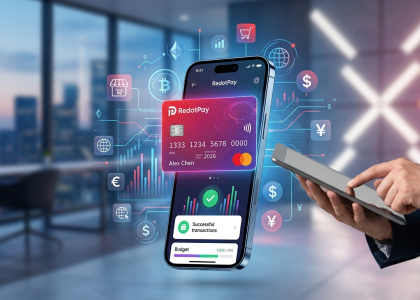
The RedotPay Virtual Card lets you top up with USDT, BTC, or ETH and pay anywhere online — instantly and securely.
- ✅ No annual fee
- ✅ Instant virtual card
- ✅ Supports USDT, BTC & ETH
- ✅ Works with Google Ads & Facebook Ads
- ✅ Global payments, fast & secure
- 🎁 Get $5 welcome bonus
Top up crypto, spend worldwide. Perfect for ads, subscriptions, and daily payments.
+1
Expert Insight: Don’t be discouraged if your region isn’t supported just yet. RedotPay’s compliance team is continuously working to add new territories as international regulations evolve, and they will notify users of updates via official emails.
If you confirm that your location is supported, you are in for a highly flexible financial experience. You will be able to use your physical card to withdraw cash at any ATM worldwide that supports major credit card networks. But as we explore the card’s global availability, I want to make sure you are fully aware of the fee structure that comes with international use.
When you make transactions in your card’s native currency, there is absolutely no fee. However, if you are traveling or spending in other currencies, you will incur a 1.2% transaction fee, alongside a standard 1% crypto conversion fee. For cash access, your costs depend on your card type and withdrawal volume. If you hold an HKD card, the ATM withdrawal fee is a flat 2%. For the USD card, you will pay a 2% fee as long as your monthly ATM withdrawals are under or equal to $10,000 USD. Should your withdrawals exceed that $10,000 USD threshold in a single month, the fee increases to 3%.

Understanding these availability guidelines and exact cost parameters early on helps us maximize the benefits of the RedotPay card while seamlessly managing our digital assets across borders.
Full List of RedotPay Supported Countries and Regions
As an expert evaluating where I can use my crypto assets, I often find that instead of relying on a restrictive list of supported countries, the true advantage lies in global network acceptance. I can confidently confirm that yes, I can withdraw cash with my physical card at any ATM that supports major credit card networks globally. To understand the full scope of regional acceptance, I always reference the official guide on Where You Can Use Your RedotPay Card.
Whenever I travel to different countries, I carefully monitor my fee structure. If I complete transactions in my card currency, there is no fee. However, if I make transactions in other currencies across different regions, a 1.2% fee applies, along with a 1% crypto conversion fee.
When I need physical cash in a supported country, my ATM withdrawal fees depend entirely on my card type and monthly volume:
- ATM withdrawal fee – HKD card: 2%
- ATM withdrawal fee – USD card: 2% (Monthly ATM Withdrawal Limits ≤ 10,000 USD)
- ATM withdrawal fee – USD card: 3% (Monthly ATM Withdrawal Limits > 10,000 USD)
If I ever encounter issues while using my card internationally, I make sure to consult the following related articles to proactively manage my account and resolve any payment problems:
- Managing Your RedotPay Card Security Settings
- What should I do if an error occurs on the RedotPay payment page?
- When the ATM cash withdrawal fails but the account balance is deducted, what should I do?
- What steps can I take to avoid payment rejections?
RedotPay Restricted Countries: Where is the Card Unavailable?
While RedotPay is designed for a global audience, regulatory landscapes and compliance requirements mean I cannot offer our services in every jurisdiction. If you are checking if your country is on the restricted list, it is essential to understand that these limitations apply to both the virtual and physical card issuance.
I currently maintain a list of restricted regions where users cannot complete the KYC (Know Your Customer) process or order a card. Generally, if you are located in the United States, Mainland China, Singapore, or sanctioned regions like North Korea, Iran, and Crimea, you will find that the app restricts registration. I constantly update these parameters based on international financial regulations and our banking partners’ requirements.
It is a common point of confusion, so let me clarify: even if you can download the app from your local store, the “restricted” status is triggered during the identity verification phase. If your country is supported, you’ll gain access to our full suite of features, including:
Regional Differences: Virtual vs. Physical Card Availability
When I first explored getting my RedotPay card, I quickly realized that availability and usability depend heavily on whether you opt for a virtual or physical card in your region. Because the platform issues cards globally, my experience showed that while the virtual card is instantly accessible in most supported countries for digital payments and online subscriptions, the physical card faces stricter mailing constraints. Delivery is restricted in certain jurisdictions due to local compliance, billing address regulations, and shipping logistics. So, while I could instantly generate a virtual card for my online spending, getting the physical counterpart delivered required verifying that my specific country wasn’t on their restricted shipping list.
If you are in a region where the physical card is available, the primary advantage is tangible ATM access. I can confirm that you can withdraw cash with your physical card at any ATM that supports major credit card networks. However, managing your costs requires knowing the exact fee structure. For my HKD card, the ATM withdrawal fee is a flat 2%. When I use my USD card, the fees depend on my usage volume: monthly ATM withdrawal limits at or below 10,000 USD incur a 2% fee, but if my monthly ATM withdrawal limits exceed 10,000 USD, the fee increases to 3%.
Whether you rely on the virtual card locally or travel internationally with the physical card, regional currency differences will inevitably impact your spending. I love that transactions in the card currency carry no fee whatsoever. On the other hand, if I make transactions in other currencies, a 1.2% fee is automatically applied. Finally, because this card bridges the gap between digital assets and fiat, I always account for the standard 1% crypto conversion fee that applies across the board whenever my crypto balance is converted to fund these purchases.
How to Verify Your Eligibility Based on Location (Local KYC Requirements)
When I first applied for my RedotPay card, I quickly realized that verifying my eligibility based on location was the most crucial initial step. Navigating local KYC (Know Your Customer) requirements might seem a bit daunting at first glance, but as someone who frequently tests crypto virtual cards, I’ve found that RedotPay’s system is highly efficient. To determine if the card is available and fully functional in your country, you must pass through their location-based identity verification gateways.
Based on my experience, the eligibility verification process requires you to submit specific documentation that proves both your identity and your residency. Here is what I always advise new users to prepare:
- Government-Issued ID: You will need to upload a clear photograph of a valid passport, national ID card, or driver’s license issued by your country of residence.
- Biometric Verification: The system will prompt you for a real-time facial scan to ensure you match the provided identification.
- Proof of Address: Depending on your jurisdiction’s specific regulatory framework, you may be prompted to provide a recent utility bill or bank statement to definitively anchor your account to an eligible region.
I strongly recommend verifying your country’s status directly through the RedotPay portal before initiating the KYC process, as regulatory landscapes shift frequently. Once my own location was verified and my KYC was approved, I was able to access the card’s financial ecosystem seamlessly.
It is also worth noting that successfully passing your local KYC directly impacts your ability to utilize physical card features and determines the fee structures you will be subject to. For instance, once you are verified and start spending, I want you to be perfectly clear on the costs: transactions in your card’s native currency incur no fees, but transactions in other currencies will carry a 1.2% fee, alongside a standard 1% crypto conversion fee. Furthermore, if your regional KYC eligibility allows you to order and use the physical card for cash access, you can withdraw cash at any ATM that supports major credit card networks. Just keep my personal fee cheat sheet in mind: ATM withdrawals on the HKD card carry a 2% fee, while the USD card charges 2% for monthly withdrawals up to 10,000 USD, and 3% if you exceed that threshold.
Overcoming Regional Restrictions: Can You Use RedotPay While Traveling?
As a crypto virtual card expert who is constantly on the move, I often receive questions about navigating regional constraints and using the RedotPay card abroad. Let me tell you from my own experience: traveling with this card is remarkably straightforward, provided you understand how the global network and fee structure work.
If you have the physical RedotPay card in your wallet, you are practically good to go anywhere in the world. I regularly use mine to withdraw cash at any ATM globally that supports major credit card networks. It is one of my favorite ways to bypass local banking restrictions and access local fiat currency directly from my crypto balance without needing a traditional bank account in the country I am visiting.
However, to make the most of it while globe-trotting, I always keep a close eye on the specific fees associated with international use. Depending on which base card you hold, the costs can vary slightly. Here is the exact breakdown I factor into my travel budget:
- ATM Withdrawals (HKD Card): When I use my HKD-denominated card at an ATM, I am charged a flat 2% withdrawal fee.
- ATM Withdrawals (USD Card): For my USD-denominated card, the fee remains at 2% as long as my monthly ATM withdrawals are ≤ $10,000 USD. If I am on an extended trip and my withdrawals exceed $10,000 USD in a month, that fee bumps up to 3%.
- Point-of-Sale Transactions: Whenever I manage to pay directly in my card’s native currency, I incur absolutely no fees. But since I am usually dealing with other foreign currencies on the road, I account for a very reasonable 1.2% fee on those transactions.
- Crypto Conversion: Regardless of where I am swiping or withdrawing, there is a standard 1% fee applied for the underlying crypto conversion.
By keeping these simple parameters in mind, I find that overcoming regional borders with RedotPay is simply a matter of knowing your numbers. As long as you are aware of the conversion and withdrawal rates, you can travel confidently, knowing your crypto portfolio is accessible at almost any ATM or payment terminal worldwide.
Best Crypto Card Alternatives If RedotPay is Not Available in Your Country
If you find that RedotPay isn’t currently supported in your region, don’t worry—the crypto card landscape is expanding rapidly. As an expert in virtual assets, I’ve vetted several alternatives that mirror the core utility of RedotPay, particularly its ability to bridge the gap between your digital wallet and everyday spending.
2. Nexo Card
If you are in the EEA, the Nexo Card is a unique beast because of its “Credit Mode.” Instead of selling your crypto and triggering a taxable event, you can spend against it as collateral. If you prefer the “Debit Mode” (spending your actual balance), the experience is nearly identical to RedotPay, offering instant conversion at the point of sale.
3. Bitrefill (The “No-KYC” Alternative)
If your country is restricted due to strict KYC regulations, I often suggest Bitrefill. While not a “card” in the traditional sense, it allows you to instantly convert crypto into digital gift cards or “virtual” cards for specific retailers. It bypasses many of the geographic hurdles that physical card issuers face while maintaining that instant conversion feel.
Want a side-by-side fee comparison between RedotPay and these alternatives?
Yes
Frequently Asked Questions About RedotPay Global Reach
I frequently receive questions from users wondering exactly how and where they can use their RedotPay card across the globe. Let me address the most common inquiries I encounter regarding our international reach, ATM usage, and associated fees.
Can I withdraw cash internationally?
Yes, you absolutely can! I always assure my readers that you can withdraw cash with your physical card at any ATM worldwide that supports major credit card networks. However, I want you to be fully aware of the fee structure so there are no surprises when you access your funds abroad.
- HKD Card: The ATM withdrawal fee is a flat 2%.
- USD Card: The fee is 2% as long as your monthly ATM withdrawal limits are ≤ 10,000 USD. If your monthly ATM withdrawal limits exceed 10,000 USD, the fee increases to 3%.
What about foreign transaction and conversion fees?
When I travel, I take comfort in knowing that transactions made strictly in the card’s native currency incur no fee. But if you are exploring the globe and making transactions in other currencies, a standard 1.2% fee applies. Additionally, because we operate in the Web3 space, keep in mind that a 1% crypto conversion fee is applied when your digital assets are converted to fiat for these purchases.
What if my transaction fails overseas?
There is nothing more frustrating than having your card declined in a foreign country. If you encounter issues—like when an ATM cash withdrawal fails but the account balance is still deducted, or if an error occurs on the RedotPay payment page—don’t panic. I highly recommend reviewing our detailed resources on Managing Your RedotPay Card Security Settings and learning the exact steps you can take to avoid payment rejections entirely.
🔥 RedotPay Virtual Card (Top Pick 2026)
The RedotPay Virtual Card lets you top up with USDT, BTC, or ETH and pay anywhere online — instantly and securely.
- ✅ No annual fee
- ✅ Instant virtual card
- ✅ Supports USDT, BTC & ETH
- ✅ Works with Google Ads & Facebook Ads
- ✅ Global payments, fast & secure
- 🎁 Get $5 welcome bonus
Top up crypto, spend worldwide. Perfect for ads, subscriptions, and daily payments.